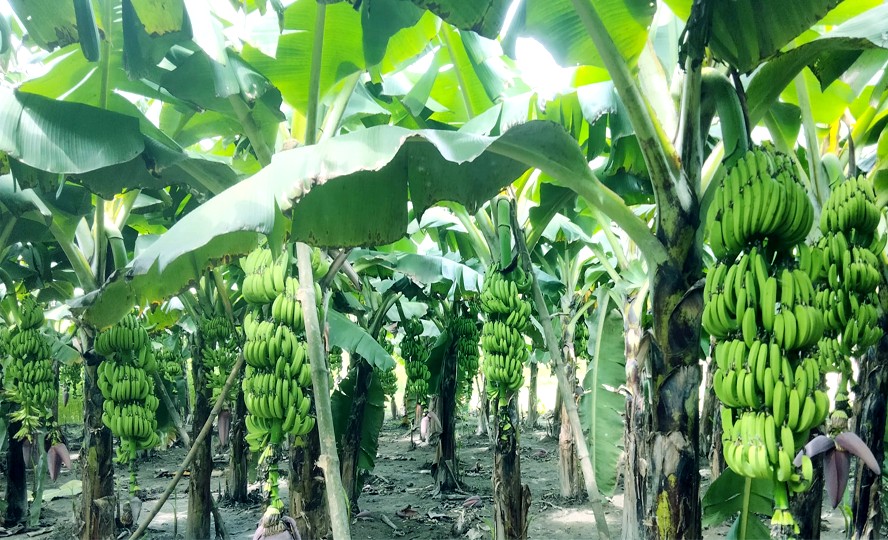
RANGPUR, 1st July 2026 – A quiet revolution in commercial banana cultivation has swept across the Rangpur agricultural region in recent years, transforming the economic landscape for countless farmers. Driven by the promise of high returns with relatively low input costs, this burgeoning sector has empowered many to achieve self-reliance within Bangladesh’s vital agricultural economy.
The fertile soils and favourable climatic conditions prevalent in the region have proven ideal for banana farming, consistently yielding bumper harvests. Coupled with satisfactory market prices, this has firmly established banana cultivation as a highly profitable and increasingly popular agricultural venture. Indeed, the allure of substantial profits from modest capital and less strenuous labour has drawn a growing number of young and educated entrepreneurs into this promising field. Various popular banana varieties, including Sagar, Malbhog, Chini Champa, and Meher Sagar, are extensively cultivated across the five districts that comprise the Rangpur agricultural zone: Rangpur, Gaibandha, Kurigram, Lalmonirhat, and Nilphamari.
However, this vibrant success story is overshadowed by a critical impediment: the severe lack of adequate preservation infrastructure and modern processing facilities. Each year, a substantial volume of harvested bananas perishes due to spoilage, directly undermining the potential profitability of this vital sector. Bananas are highly perishable, and once harvested, they must be swiftly transported to market to avoid rapid deterioration. This inherent fragility exacerbates the challenges faced by smallholder farmers who lack access to immediate sales channels or appropriate cold storage solutions. The issue of post-harvest loss is a common problem in many developing agricultural economies, often impacting farmers’ income significantly and contributing to food waste.
According to figures from the Department of Agricultural Extension (DAE), the scale of banana production in the region underscores both its impressive growth and the magnitude of the post-harvest challenge. In the 2022-23 fiscal year, banana cultivation spanned 4,208 hectares, yielding an impressive 112,357 metric tonnes. Production saw a significant increase in the subsequent 2023-24 fiscal year, with 134,227 metric tonnes harvested from 4,356 hectares. The upward trend continued into the 2024-25 fiscal year, where farmers produced 134,916 metric tonnes of bananas across 4,077 hectares in the five aforementioned districts. This burgeoning output translates into millions of taka in daily sales across bustling markets such as Shothibari Haat in Mithapukur upazila, Palashbari Haat and Phasitala Haat in Gaibandha, and various other selling points along the Rangpur-Dhaka highway.
Despite these impressive production figures and market activity, many farmers find their earnings curtailed by the very success of their harvests. Hamidur Rahman, Bokul Mia, and Anwar Hossain, farmers from Takeya village in Rangpur’s Mithapukur upazila, shared how banana cultivation has profoundly improved their livelihoods in recent years. Yet, they lament the pervasive issue of post-harvest losses. During periods of abundant yield, they are often compelled to sell their produce at heavily discounted prices to middlemen and ‘farias’ – informal traders – simply due to the absence of cold storage or specialised preservation facilities. “Even a slight delay causes the bananas to start rotting,” farmer Anwar Hossain explained, “which means we can’t secure the profit we anticipate.” This forces them into distress sales, eroding a significant portion of their potential income.
The absence of processing centres or specialised cold storage facilities in the Rangpur region remains a glaring gap, particularly when considering the consistent bumper harvests the area produces. Farmers like Masudur Rahman, Saju Mia, and Habibur Rahman from Paikantari village in Lalmonirhat’s Kaliganj upazila detailed the economics: cultivating one acre of land typically costs between BDT 100,000 and BDT 120,000, accommodating approximately 1,000 banana saplings. A good harvest can see each banana bunch fetch between BDT 450 and BDT 600, potentially generating an annual income of BDT 350,000 to BDT 450,000 per acre. This substantial earning potential, however, is frequently undercut by spoilage and the lack of market power for individual farmers.
Ishaq Ali, a farmer from Kathihara village in Rangpur Sadar, advocates for the establishment of cold storage facilities or specialised collection centres adjacent to major banana markets, considering the fruit’s nutritional value and versatile uses. Such infrastructure, he argues, would not only benefit farmers and traders financially but also also ensure consumers have year-year-round access to fresh, chemical-free bananas at fair prices. This would represent a significant step towards a more efficient and equitable agricultural supply chain.
Mostafa Sohrab Chowdhury Titu, former President of the Rangpur Chamber of Commerce and Industry, echoed these sentiments in a conversation with BSS. He stressed that implementing modern banana preservation and processing systems in the Rangpur region could usher in a significant positive transformation for both the national and local economies. His recommendations include facilitating low-interest bank loans for farmers, establishing temperature-controlled cold storage units, developing factories for banana-based food products, introducing modern packaging solutions, and promoting natural ripening technologies. These measures could also open avenues for value-added products, such as banana chips, flour, or purées, thereby creating new market opportunities and employment.
Md. Sirajul Islam, Additional Director of the DAE in the Rangpur region, confirmed that the area dedicated to banana cultivation continues to expand each year. He highlighted that the DAE’s extensive motivational programmes are encouraging farmers to broaden their banana cultivation efforts, thereby fostering self-reliance, meeting nutritional requirements, enhancing immunity, and contributing robustly to the national economy. The full realisation of these manifold benefits, however, hinges on urgently addressing the crucial post-harvest challenges that currently plague this otherwise flourishing agricultural sector.